Rebar Rolling Mill Production Process

Rebar Rolling Mill Production Process
First, the Production Process of Rebar Rolling Mill
Rebar is a ribbed steel bar, also known as a ribbed steel bar, usually with two longitudinal ribs and horizontal ribs evenly distributed along the length. The shape of the horizontal ribs is spiral, herringbone, and crescent. Expressed in millimeters of the nominal diameter. The nominal diameter of the ribbed steel bars is equivalent to the nominal diameter of the light round bars with equal cross sections. The nominal diameter of the steel bar is 8-50 mm, and the recommended diameter is 8, 12, 16, 20, 25, 32, 40 mm. Ribbed steel bars are mainly subjected to tensile stress in concrete. Ribbed steel bars have a greater bonding capacity with concrete due to the role of ribs, and therefore can better withstand external forces. Ribbed steel bars are widely used in various building structures, especially large, heavy, light thin-walled and high-rise building structures.
Rebar is produced by small rolling mills. The main types of small rolling mills are divided into continuous, semi-continuous and horizontal. At present, most of the newly built and in-use small continuous rolling mills in the world. Today's popular rebar mills include general-purpose high-speed rolling rebar mills and 4-segment high-throughput rebar mills.
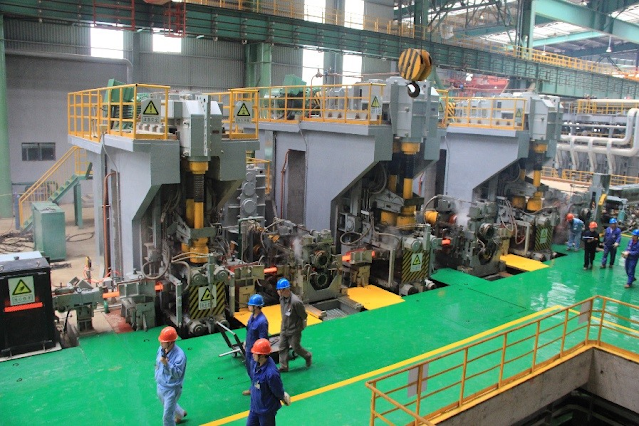
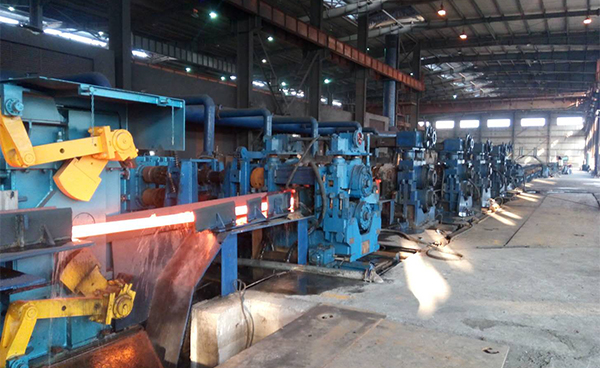
The billets used in continuous small rolling mills are generally continuous cast billets, the side length of which is generally 130 ~ 160mm, the length is generally about 6-12 meters, and the billet weight is 1.5 ~ 3 tons. Most of the rolling lines are arranged alternately horizontally and vertically to achieve twist-free rolling on the entire line. According to different billet specifications and finished product sizes, there are 18, 20, 22, 24 small rolling mills, 18 of which are mainstream. At present, new technologies such as step-type heating furnaces, high-pressure water descaling, low-temperature rolling, and endless rolling are used for bar rolling. Rough rolling and intermediate rolling are developed to adapt to large billets and improve rolling accuracy. Finishing mills Mainly to improve accuracy and speed (up to 18m / s). Product specifications are generally ф10-40mm, there are also ф6-32mm or ф12-50mm. The steel types produced are low-medium-high-carbon steels and low-alloy steels that are in large demand in the market; the maximum rolling speed is 18m / s. Its production process is as follows:
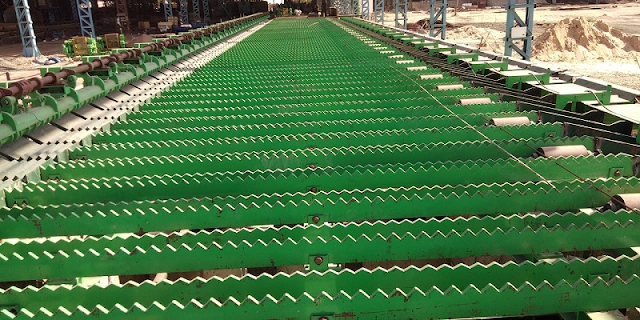
Stepping furnace → rough rolling mill → intermediate rolling mill → finishing rolling mill → water cooling device → cold bed → cold shear → automatic counting device → bundling machine → unloading stand
Second, The Characteristics and Quality of Rebar
1. Classification of rebar
There are two commonly used classification methods for rebar: one is to classify by geometry, and to classify or type according to the cross-sectional shape of the ribs and the spacing of the ribs. For example, in the British Standard (BS4449), rebar is divided into type I, Type II. This classification mainly reflects the grip performance of rebar. The second is the performance classification (grade). For example, according to the Chinese standard (G B1499.2-2007), the rebar is divided into 3 grades according to the strength level (yield point / tensile strength); the Japanese Industrial Standard (JI SG3112) According to the comprehensive performance, the rebar is divided into 5 types; the British Standard (BS4461) also specifies several levels of rebar performance tests. In addition, the rebar can be classified according to use, such as ordinary steel bars for reinforced concrete and heat treated steel bars for reinforced concrete.
In accordance with national standards, hot-rolled ribbed steel bars for reinforced concrete in our country are composed of the minimum yield point of HRB and the grade. H, R, and B are the first letters of the three words, Hotrolled, Ribbed, and Bars. Hot-rolled ribbed steel bars are divided into three brands: HRB335 (the old brand is 20MnSi), HRB400 (the old brand is 20MnSiV, 20MnSiNb, 20Mnti) and HRB500.
2. Specifications and Quality of Rebar
The principle of ordering rebar is generally based on meeting the requirements of grip performance required by engineering design, and mainly based on mechanical process performance or mechanical strength indicators.
Specifications: The specifications of rebar should be specified in the import and export trade contract. Generally it should include the standard grade (type code), the nominal diameter of the steel bar, the nominal weight (mass), the specified length and the allowable difference of the above indicators. Chinese standards recommend a series of rebars with nominal diameters of 8, 10, 12, 16, 20, and 40 mm. All quality requirements should meet the requirements of GB1499.2-2007 "Hot-Rolled Ribbed Steel Bar".
Appearance quality: ①Surface quality. Relevant national standards have stipulated the surface quality of rebar, requiring the ends to be cut straight, the surface must be free of cracks, scars, and folds, and there must be no harmful defects in use; ②Allowable deviations in external dimensions. The requirements for the curvature of the rebar and the geometry of the rebar are specified in the relevant national standards. For example, according to China's national standards, the bending degree of straight bars is not greater than 6mm / m, and the total bending degree is not greater than 0.6% of the total length of the reinforcing bars.
Grades and chemical composition of hot rolled ribbed steel bars for reinforced concrete:
Chemical composition (%)
C Si Mn P S Ceq
HRB335 0.25 0.8 1.6 0.045 0.045 0.52
HRB400 0.25 0.8 1.6 0.045 0.045 0.54
HRB500 0.25 0.8 1.6 0.045 0.045 0.55
Chemical Composition Inspection:
(1) Inspection methods: The standard inspection methods commonly used in the inspection and analysis of the above chemical components are as follows: GB / T223, JISG1211? 1215, BS1837, BS Manual 19, etc.
(2) Composition index: The indicators for evaluating the content of rebar are: C, Mn, P, S, Si, etc. The content is different for different brands, and the approximate range is: C (0.10 ~ 0.40%), Mn <1.80%, P <0.050%, S <0.050%, Si (0.60 to 1.00%).
Mechanical performance inspection:
(1) Performance indicators: Inspection items for evaluating the mechanical properties of rebar include tensile tests (tensile strength, yield strength, and elongation), and bending tests (one-time bending and reverse bending).
(2) Inspection method: ① Tensile test method: Common standard inspection methods are GB / T228-87, JISZ2201, JI SZ2241, ASTMA370, ГОСТ1497, BS18, etc .; ② Bending test method: Common standard inspection methods are GB / T232 -88, JISZ2248, ASTME290, ГОСТ1401 9 and so on.
Rebar is generally delivered in bare bundles. Pay attention to moisture resistance during storage. Corrosion will adversely affect the performance of rebar.
Third, The Use of Rebar
Rebar is widely used in civil engineering construction of houses, bridges and roads. From public facilities such as highways, railways, bridges, culverts, tunnels, flood control, dams, etc., to foundations, beams, columns, walls, slabs, and rebar of building construction, all are indispensable structural materials.
With the continuous deepening of the degree of urbanization in China, the booming development of infrastructure construction and real estate has a strong demand for rebar. Reinforced concrete structure is still the main structural form of China's architecture for a long time at present and in the future. Therefore, it can be expected that the rebar demand and output will remain at a high level.
According to statistics, the amount of steel used in the construction industry in China accounts for about 50% of the total steel consumption. As one of the industries with a large resource consumption, the construction industry must adjust the consumption structure of building materials to achieve sustainable development, vigorously apply high-strength steel bars and high-performance concrete, and follow the path of economical development. If the reinforcement and concrete currently used can be increased by one strength level, it can bring huge savings to society.
According to calculations, if the strength of the main reinforced concrete reinforced reinforced concrete can be increased to 400-500N / mm2 according to the requirements of the code, it can save about 10% on the current level of steel consumption.






GLI provide testing, certification and skilled companies to the global gaming industry. The GLI also undertake auditing, area inspections and https://casino.edu.kg/1xbet-korea.html safety audits, and they work with gaming regulators, suppliers, and operators, with an goal of ensuring the integrity of the gaming industry.
回复删除